

Breastfeeding With a Low Milk Supply: What Helped Me
(Hey! Some links in this post may be affiliate links — meaning I may earn a small commission if you buy through them, at no extra cost to you. As an Amazon Associate, I earn from qualifying purchases. I only share products I genuinely love and think you’ll find useful too. Read the full disclosure here).
It was 2 a.m., and I was staring at the pump bottles again. One ounce. Maybe one and a half if I was generous with the measurement. My baby had just nursed for forty minutes and was still rooting around, clearly still hungry. I’d read all the things about breast being best, and here I was, barely producing enough to keep her satisfied for an hour.

If you’re reading this with that same sinking feeling in your chest, I want you to know something right now: you’re not broken. Low milk supply is real, it’s more common than anyone talks about, and there are actual things that can help. Not magic fixes, but real strategies that made a difference for me.
Here’s what actually worked when I was desperately Googling at 3 a.m., and what I wish someone had told me from the start.
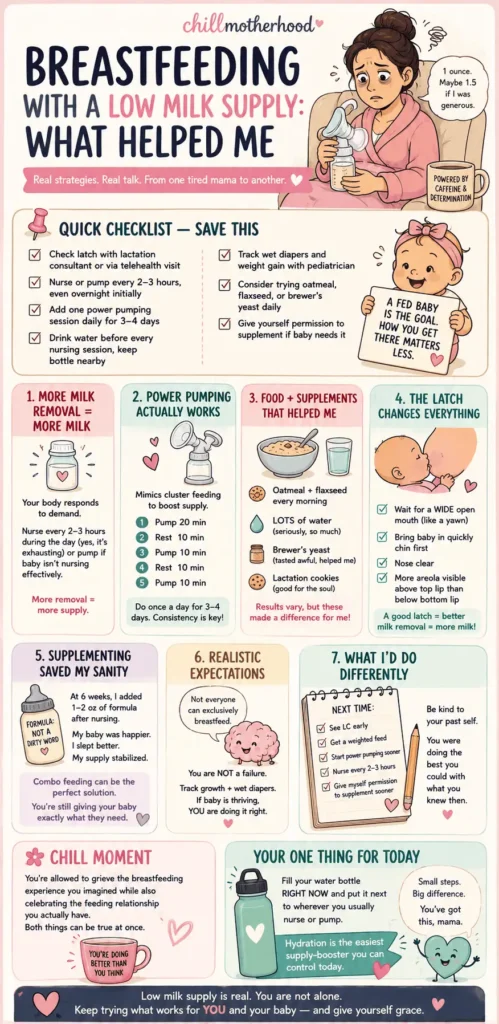
📌 Quick Checklist — Save This
- ✅Check latch with lactation consultant or via telehealth visit
- ✅Nurse or pump every 2-3 hours, even overnight initially
- ✅Add one power pumping session daily for 3-4 days
- ✅Drink water before every nursing session, keep bottle nearby
- ✅Track wet diapers and weight gain with pediatrician
- ✅Consider trying oatmeal, flaxseed, or brewer’s yeast daily
- ✅Give yourself permission to supplement if baby needs it
The First Thing I Wish I’d Known About Breastfeeding With Low Milk Supply
Low supply doesn’t always mean what you think it means. I spent two weeks convinced I wasn’t making enough milk because my baby wanted to nurse constantly and I couldn’t feel the “let-down” everyone described.
Turns out, cluster feeding is completely normal, and not everyone feels their milk release. What actually matters? Wet diapers (at least 6-8 after the first week) and steady weight gain.
Before you do anything else, get an actual assessment. I finally saw a lactation consultant at week three, and she did a weighted feed — baby nurses, you weigh them before and after to see exactly how much they got. That single appointment gave me real data instead of just anxiety.
What Actually Increased My Milk Supply
Here’s the truth nobody wants to hear: the most effective thing for low milk supply is more milk removal. Your body responds to demand. The more often milk is removed (by nursing or pumping), the more your body thinks it needs to make.
I started nursing every two to three hours during the day, even if my baby wasn’t asking. It was exhausting. But within four days, I noticed my breasts felt fuller, and she seemed more satisfied after feeds.
If your baby isn’t nursing effectively, pumping counts too. I added one pumping session after the first morning feed when my supply was naturally highest. Those extra few ounces in the freezer felt like gold.

Power Pumping for Low Milk Supply (And Why It Worked)
Power pumping sounds intense, but it’s basically mimicking cluster feeding to trick your body into thinking there’s higher demand. Here’s the schedule I used:
- Pump for 20 minutes
- Rest for 10 minutes
- Pump for 10 minutes
- Rest for 10 minutes
- Pump for 10 minutes
I did this once a day, usually in the evening while watching something mindless on TV. After three days, I noticed I was getting an extra half ounce per regular pumping session. Not a miracle, but real progress.
Don’t expect massive results overnight. Your body needs consistent signals over several days to adjust production. I kept it up for about a week before scaling back.
Foods and Supplements That Made a Difference for Breastfeeding
I’m not going to promise that oatmeal will magically fix everything, but some things genuinely seemed to help me. The science is mixed, but when you’re desperate, you try what might work.
What I added to my routine:
- Oatmeal every morning — I made overnight oats with flaxseed and honestly don’t know if it was the oats or just eating a real breakfast for once
- Lots of water — I kept a 32-ounce bottle next to my nursing chair and refilled it twice daily
- Brewer’s yeast — added it to smoothies, tasted awful, but my supply did increase that week
- Lactation cookies — more about the ritual than the results, but they tasted good and gave me something to look forward to
I tried fenugreek capsules too, but they made me smell like maple syrup and gave me heartburn. Some people swear by them, but they weren’t for me. Your mileage will definitely vary.

The Latch Fix That Changed Everything
This is the thing I wish I’d addressed in week one instead of week four. My baby’s latch looked fine to me — she was on the breast, she was sucking, what else was there?
Turns out, a shallow latch means your baby isn’t effectively emptying your breast, which signals your body to make less milk. It’s a frustrating cycle.
The lactation consultant watched one feeding and immediately saw the issue. My baby wasn’t opening wide enough, so she was mostly getting the nipple instead of a big mouthful of breast tissue.
The fix: wait for her to open really wide (like a yawn), then bring her onto the breast quickly. Her chin should touch first, nose should be clear, and you should see more areola visible above her top lip than below her bottom lip.
Within two days of fixing the latch, my nipples hurt less and she seemed more satisfied. My supply increased noticeably over the next week.
When I Added Formula and Stopped Feeling Guilty
At six weeks, I was doing everything “right” and still barely producing enough. My baby was gaining weight, but slowly. My pediatrician suggested supplementing with one to two ounces of formula after nursing sessions.
I cried in the parking lot. I felt like I was failing.
But here’s what happened: my baby was happier. She slept better. And because I wasn’t stressed and exhausted all the time, my milk supply actually stabilized. Sometimes your body needs you to relax before it can do its thing.
Combo feeding ended up being our solution. I nursed first every time, then topped her off with formula as needed. She still got breast milk. She also got enough food. I got to keep some of my sanity.

Realistic Expectations for Breastfeeding With Low Supply
Not everyone can exclusively breastfeed. Some bodies just don’t produce a full supply, no matter what you do. Hormonal issues, previous breast surgeries, insufficient glandular tissue — these are real medical factors.
I increased my supply from barely an ounce per pumping session to about three ounces. That’s not nothing. But it also wasn’t enough to exclusively breastfeed.
If you’re doing everything you can and it’s still not enough, that’s not a reflection of your worth as a mother. Your baby needs you healthy and present more than they need exclusively breast milk.
Track your baby’s growth and wet diapers. If they’re thriving, you’re doing it right — whether that’s all breast milk, mostly breast milk, or half and half.
What I’d Do Differently Next Time
If I could go back, I’d see a lactation consultant in the hospital or within the first week. I’d ask for a weighted feed immediately instead of guessing for a month.
I’d start power pumping earlier, and I’d be more consistent about nursing every two to three hours even when it felt relentless.
Most importantly, I’d give myself permission to supplement sooner. The weeks I spent crying over ounces were weeks I could’ve spent actually enjoying my baby.
🌸 Chill Moment
You’re allowed to grieve the breastfeeding experience you imagined while also celebrating the feeding relationship you actually have. Both things can be true at once.
Your one thing for today
Fill your water bottle right now and put it next to wherever you usually nurse or pump. Hydration is the easiest supply-booster you can control today.
Conclusion
The morning I finally stopped obsessing over every ounce and just focused on whether my baby was happy, everything shifted. She was gaining weight. She had plenty of wet diapers. She smiled at me between feeds. That’s what actually mattered.
Breastfeeding with low milk supply is hard, and it’s okay to acknowledge that while also doing what works for your family. Save this for later when you need the reminder, and check out our post on combo feeding if you’re considering that route too.