
Why We Cosleep: The Truth About Bedsharing
(Hey! Some links in this post may be affiliate links — meaning I may earn a small commission if you buy through them, at no extra cost to you. As an Amazon Associate, I earn from qualifying purchases. I only share products I genuinely love and think you’ll find useful too. Read the full disclosure here).
It’s 2 a.m. and you’re standing in the hallway again, swaying back and forth with a drowsy baby who keeps jerking awake the second you lower her toward the crib. You’ve done this dance four times tonight already. Your partner’s asleep. Your back hurts. And you’re thinking about that empty space right next to you in bed—the one that’s warm, safe, and exactly where your baby keeps trying to curl up anyway.

So maybe you’ve started cosleeping. Or maybe you’re thinking about it but scrolling through conflicting advice at 3 a.m., trying to figure out if you’re brave or reckless or just exhausted enough that it doesn’t matter anymore.
Here’s the truth: bedsharing isn’t one-size-fits-all, and it’s definitely not the parenting controversy it’s made out to be. Let’s talk about why some families cosleep, what actually matters for safety, and how to make the choice that works for your family—not the internet’s.
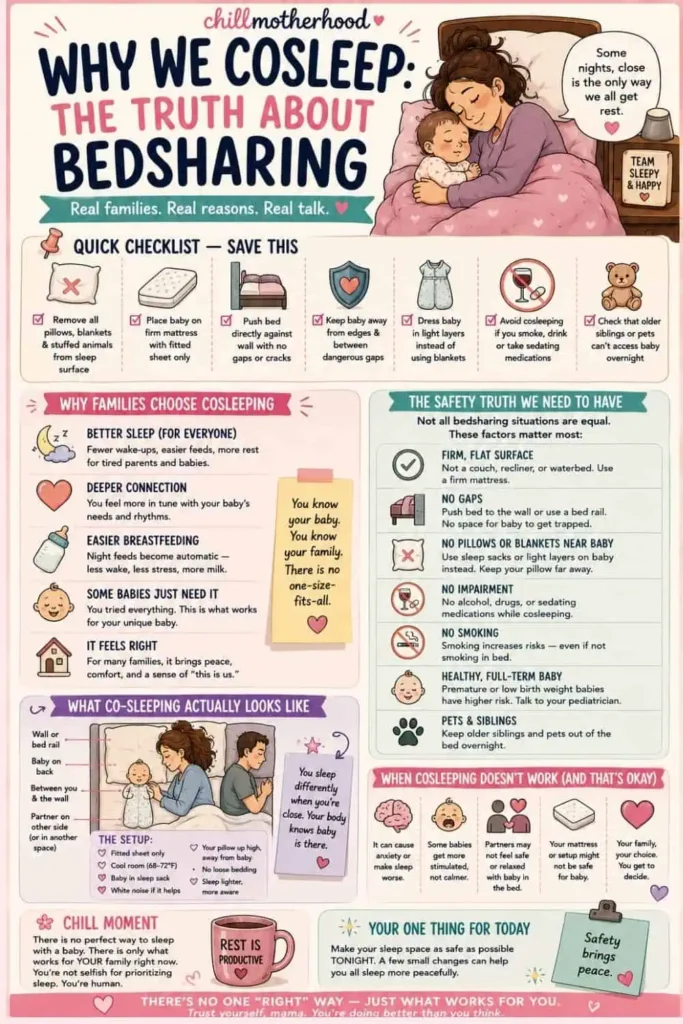
📌 Quick Checklist — Save This
- ✅Remove all pillows, blankets, and stuffed animals from sleep surface
- ✅Place baby on firm mattress with fitted sheet only
- ✅Push bed directly against wall with no gaps or cracks
- ✅Keep baby away from edges and between dangerous gaps
- ✅Dress baby in light layers instead of using blankets
- ✅Avoid cosleeping if you smoke, drink, or take sedating medications
- ✅Check that older siblings or pets can’t access baby overnight
Why Families Choose Bedsharing (And It’s Not Just About Sleep)
Yes, everyone talks about the sleep. And honestly? That’s a huge part of it. When you’re cosleeping, you’re not getting up twelve times a night. You’re not fully waking up for every feed. You’re rolling over, nursing or soothing, and drifting back down without ever really surfacing.
But here’s what people don’t talk about as much: it just feels right for some families. Not all. Not even most. But for the ones who do it, there’s often this sense of—oh, this is what we needed all along.
You get more sleep, sure. But you also get those tiny hand pats on your arm at 5 a.m. The little sighs. The way your baby instinctively curls into you. Some parents describe it as feeling more connected, more in tune. You notice every sound, every shift, every breath—not in an anxious way, but in a deeply calm, mammal-brain way.
For breastfeeding parents especially, bedsharing can make night feeds almost automatic. You barely wake up. Baby barely wakes up. You’re both back asleep in minutes instead of spending 45 minutes in a chair trying to keep your eyes open.
And let’s be honest: some babies just won’t sleep any other way. You can follow every sleep training guide, buy every bassinet, try every trick—and your kid still wakes up screaming the second they’re not touching you. So you adapt.

The Safety Conversation We Actually Need to Have About Cosleeping
This is where it gets tricky, because the official recommendations say room-sharing yes, bedsharing no. And that’s based on real data about risk factors. But it’s also not the whole story.
The truth is, not all bedsharing situations are equal. A sober, non-smoking parent on a firm mattress with no pillows or blankets near the baby is a completely different scenario than an impaired adult on a couch with loose bedding. The risks aren’t the same.
So if you’re going to cosleep—or if you’re already doing it—here’s what actually matters:
- Firm, flat surface. Not a couch, not a recliner, not a waterbed. A real mattress, firm enough that baby doesn’t sink in.
- No gaps. Push the bed against the wall or use a bed rail. Babies can get trapped in the space between mattress and wall, or mattress and frame.
- No pillows or blankets near baby. Use sleep sacks or light layers on baby instead. You can have your own pillow, just keep it far from their face.
- No impairment. If you’ve been drinking, using drugs, or taking anything that makes you drowsy, baby needs to sleep somewhere else that night.
- No smoking. Even if you don’t smoke in bed, smoking increases risks related to bedsharing. It’s one of the bigger red flags.
- Healthy, full-term baby. Premature or low birth weight babies have higher risk. Talk to your pediatrician.
Some families split the difference with a bedside bassinet or cosleeper—baby’s in their own space but right next to you, within arm’s reach. It’s a middle ground that works really well for people who want closeness but feel uncertain about bedsharing.
What Cosleeping Actually Looks Like in Real Life
Let’s get practical. If you’re setting up for bedsharing, here’s what a safer sleep space actually involves:
Your bed is stripped down. Fitted sheet, that’s it. Your pillow is up near the headboard, nowhere near where baby sleeps. Baby’s in a sleep sack or lightweight onesie depending on room temp—nothing loose, nothing that could cover their face.
You position baby on their back, between you and the wall (or a mesh bed rail if you don’t have a wall). Not between two adults—partners sleep on the other side of you, or in another space entirely for the first few months. Older siblings and pets are in separate rooms.
The room is cool, around 68-72°F. You might be a little chilly without your usual blankets, but baby’s comfortable. You’ve got a white noise machine going if that helps everyone sleep.
And here’s the thing nobody tells you: you sleep differently when you’re cosleeping. Most parents describe sleeping lighter, more aware. You’re not passed-out oblivious. You’re in this semi-alert state where you just know where baby is. It’s instinctive.

When Bedsharing Doesn’t Work (And That’s Okay Too)
Not everyone loves cosleeping. Some parents try it and feel anxious all night. Some babies sleep worse in bed with you—they smell milk and want to nurse every hour, or they’re distracted by your presence and can’t settle.
Some partners can’t relax with baby in the bed. Some families just don’t have the right setup—maybe your mattress is too soft, or your bedroom’s too small, or you’ve got a toddler who still climbs in at night and you can’t safely manage both.
If bedsharing isn’t working, that doesn’t mean you’re doing anything wrong. It means you’re paying attention and adjusting. That’s good parenting.
Plenty of families do the first few months in a bassinet, then transition to a crib. Or they start bedsharing and move baby out when it stops working for everyone. Or they never bedshare at all and everyone sleeps great. All of these are fine.
The Middle-of-the-Night Reality Check About Cosleeping
Here’s what I wish someone had told me early on: a lot of families who say they don’t cosleep actually do—at least sometimes. Maybe it’s just the last few hours before morning. Maybe it’s only on really rough nights. Maybe it started accidentally and now it’s just what happens.
There’s this gap between what we say we do and what we actually do at 4 a.m. when we’re barely conscious. And that gap matters, because if you’re falling asleep with baby in your bed unintentionally, that’s often less safe than planning for it and setting up properly.
So if you think there’s any chance you might drift off during a night feed, set up your bed as if you’re bedsharing on purpose. Clear the pillows. Ditch the blankets near baby. Move to a safe surface. That way, if it happens, you’re already in a safer situation.
This isn’t about judgment. It’s about being honest with yourself so you can make the safest choice for your actual life—not your theoretical one.

How to Talk About Bedsharing Without Losing Your Mind
If you’re bedsharing, you’ve probably already discovered that it’s one of those topics people have opinions about. Your pediatrician might lecture you. Your mother-in-law might panic. The internet will definitely have thoughts.
Here’s the thing: you don’t owe anyone a detailed explanation of your sleep setup. “We’re doing what works for our family” is a complete sentence. So is “Baby’s sleeping great, thanks for asking.”
If your pediatrician is anti-bedsharing but you’re doing it anyway, you can still be honest—just frame it in terms of harm reduction. “I know the recommendations, and here’s what we’re doing to make it as safe as possible.” Most pediatricians would rather know the truth so they can help you optimize safety than have you lie and get no guidance at all.
And if you’re in online parenting groups? Just know that bedsharing threads always get heated. Protect your peace. You don’t need to defend your choices to strangers who aren’t living your 3 a.m. reality.
What Changes as Baby Grows and Cosleeping Evolves
Bedsharing with a two-month-old looks completely different than bedsharing with a ten-month-old. Tiny babies stay where you put them. Older babies roll, scoot, and somehow end up sideways across the entire bed with their feet in your face.
Some families find that bedsharing works beautifully for the first six months and then gets chaotic. Others find their groove once baby’s a little older and less fragile-feeling. There’s no single trajectory.
As babies get more mobile, you might need to adjust your setup—moving the mattress to the floor, for example, so there’s no fall risk. Or creating a floor bed situation where everyone’s safe even if baby rolls off.
And at some point, many families transition out of bedsharing. Sometimes it’s because baby’s ready. Sometimes it’s because you’re ready and you want your bed back. Sometimes it happens gradually, with baby starting the night in their own space and joining you later.
There’s no perfect time to transition. You’ll know when it’s right—or when it’s necessary because someone’s not sleeping well anymore.
🌸 Chill Moment
Whatever you’re doing right now—bedsharing, crib sleeping, some chaotic combination—if everyone’s getting enough rest to function, you’re doing it right. Sleep arrangements aren’t moral choices.
Your one thing for today
Take one pillow off your bed tonight and see if it makes your sleep space feel safer—that’s it, just one small shift.
Conclusion
The truth about bedsharing is that it’s not a debate you need to win—it’s a choice you make based on your family, your baby, your sleep, and your gut. Some nights you’ll wake up with a tiny starfish sprawled across your chest and feel grateful for the closeness. Other nights you’ll wonder if you’ll ever sleep alone with your partner again. Both feelings can exist at the same time.
Save this for later when you’re second-guessing yourself at 2 a.m., or share it with a friend who’s trying to figure out what’s right for her family. And if you’re looking for more real talk about the early days, check out our post on surviving the fourth trimester—it’s full of the honest stuff nobody mentions at baby showers.